
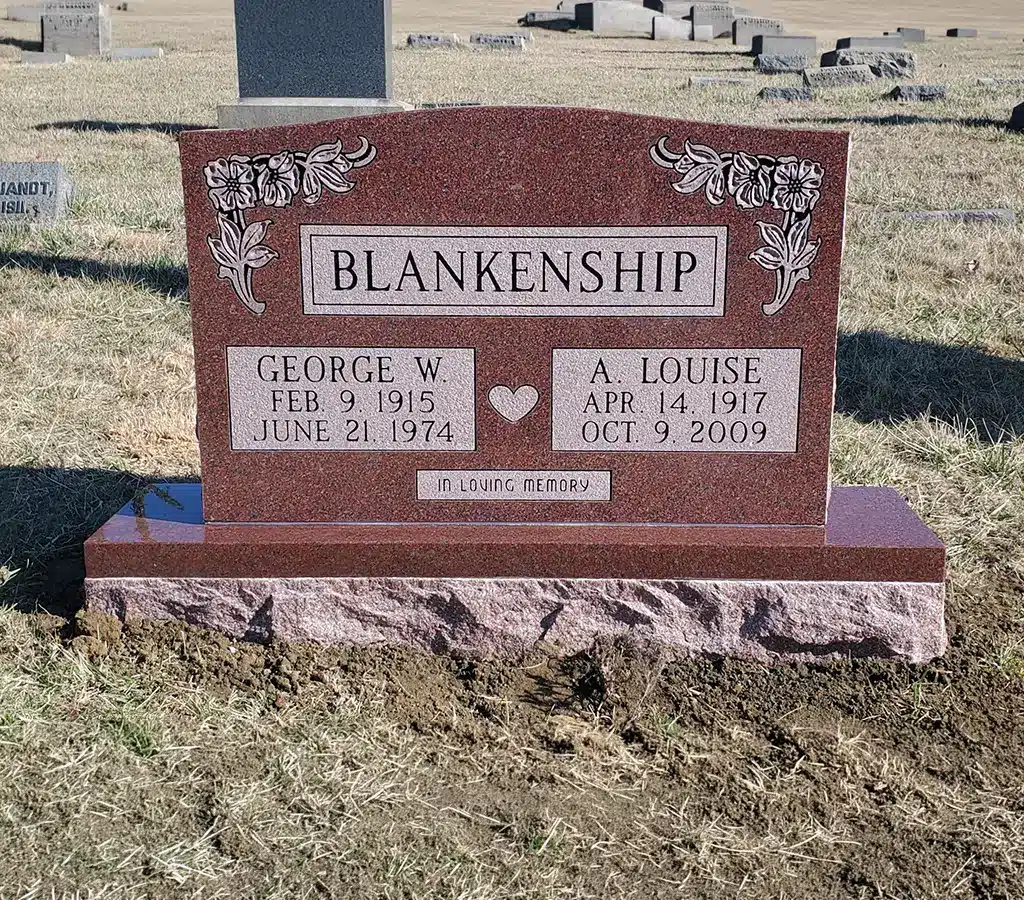
Choosing the words that will appear on a loved one’s headstone can be difficult. When a memorial is being created for a husband and wife, there is another consideration: How do you honor two individual lives while also recognizing the life they shared together?
A husband-and-wife headstone, often called a companion headstone, double headstone, or couples headstone, can include names, dates, a shared family name, a meaningful epitaph, religious imagery, symbols, and other details that tell part of the couple’s story.
There is no single correct format. Some couples prefer a simple inscription containing only their names and dates. Others choose a more personalized monument incorporating a wedding date, family information, a favorite quotation, or words that reflect their relationship.
If you are planning a headstone for a husband and wife, the following ideas can help you decide what belongs on the memorial and how the different elements can work together.
What Is Typically Written on a Husband-and-Wife Headstone?
Most husband-and-wife headstones begin with the same essential information found on an individual memorial:
- The name of each person
- Birth dates
- Death dates
- A shared surname, when appropriate
- A short epitaph or memorial phrase
Beyond these basics, the inscription can be personalized considerably. Depending on the couple and the amount of space available, a companion memorial might also include a wedding date, religious verse, military designation, parental role, artwork, symbols, or a phrase meaningful to the family.
The goal is not necessarily to include as much information as possible. A thoughtful inscription often communicates more with a few carefully chosen words.
1. Decide How the Couple’s Names Will Appear
The names are usually the most prominent part of a companion headstone, so deciding how they will be presented is a good starting point.
One traditional arrangement is to place the shared surname prominently across the top or center of the monument, with each spouse’s first and middle names beneath it.
For example:
MARTIN
James Edward
1942–2021
Margaret Anne
1945–2024
Another option is to present both full names individually:
James Edward Martin
1942–2021
Margaret Anne Martin
1945–2024
Couples who did not share a surname can simply have each person’s full name displayed on their respective side of the monument. There is considerable flexibility here. The appropriate arrangement depends on the couple’s preferences, the monument style, cemetery requirements, and how much additional information will be incorporated into the design.
2. Include Birth and Death Dates
Birth and death dates are among the most common elements of a husband-and-wife headstone inscription. Dates can be written in several ways.
A memorial might use years only:
1942–2021
Or complete dates:
March 12, 1942 – October 8, 2021
Some families prefer abbreviated months or numeric dates.
Using years alone creates a particularly clean appearance and leaves additional room for an epitaph or artwork. Full dates provide more biographical detail but require additional inscription space.
Whichever format is selected, using the same date style for both spouses generally creates the most cohesive design.
What If One Spouse Is Still Living?
It is common for a companion headstone to be purchased while one spouse is still living. In that situation, the living spouse’s name and birth date may be engraved when the monument is created, with space intentionally left for the death date to be added later.
For example:
Robert
1938–2020
Eleanor
1941–
Planning for the future inscription is important. The monument company can account for the amount of space required and design the original lettering so the completed memorial will remain visually balanced.
3. Consider Including the Couple’s Wedding Date
For some couples, their marriage is one of the defining chapters of their lives. Including a wedding date can recognize that history without requiring a lengthy inscription.
It might appear as:
Married June 18, 1966
Together Since 1972
United in Marriage May 4, 1958
Another option is to incorporate wedding rings, intertwined rings, hearts, or another symbol alongside the date. A wedding date can be particularly meaningful on a companion memorial because it adds another important milestone beyond each person’s birth and death dates.
4. Choose a Shared Epitaph
An epitaph is a short phrase or statement inscribed on a memorial. On a husband-and-wife headstone, families can choose one epitaph for the couple or separate words beneath each person’s name. A shared epitaph can emphasize love, family, faith, or the life the couple built together. Some simple husband-and-wife headstone sayings include:
- Together Forever
- Forever in Our Hearts
- Together in Life, Together in Memory
- A Life of Love, A Legacy of Family
- Our Love Lives On
- Always Together
- Forever Loved, Forever Remembered
- Two Lives, One Love
- Together Through Life’s Journey
- Love Is Eternal
- Devoted to Each Other and Their Family
- Their Love Was Their Greatest Legacy
The phrase does not need to specifically mention marriage. Sometimes a few words that reflect the couple’s values are more personal than a traditional romantic epitaph.
5. Consider Separate Words for Each Spouse
A companion headstone celebrates a shared life, but it also commemorates two individuals. Families sometimes choose a brief description or phrase for each spouse.
For example:
John Michael Carter
1940–2020
Beloved Husband & Father
Mary Louise Carter
1943–2025
Beloved Wife & Mother
Other possibilities include:
Devoted Father
Devoted Mother
or:
Loving Husband, Father & Grandfather
Loving Wife, Mother & Grandmother
These descriptions can recognize each person’s individual role within the family while the overall monument connects them as a couple.
- Incorporate Children and Family
For many couples, family is an important part of the story they want their memorial to tell.
A simple inscription might say:
Beloved Parents and Grandparents
or:
Loving Parents of Michael, Susan & David
Some companion memorials incorporate family imagery instead of listing names. A tree, for example, can represent generations of a family, while flowers, branches, or other elements may be incorporated into the monument’s design.
When deciding whether to list children or other relatives, consider the amount of available space. A crowded inscription can make a memorial more difficult to read and may leave less room for future additions.
7. Use Religious or Spiritual Inscriptions
For couples whose faith was central to their lives, a religious inscription can be an appropriate part of the memorial.
Examples include:
- Rest in Peace
- Until We Meet Again
- In God’s Loving Care
- Forever With the Lord
- Safe in the Arms of Jesus
- Blessed Are the Pure in Heart
- Faithful in Life, Together in Eternity
A family might also select a brief passage or reference from Scripture. Religious symbols such as a cross, praying hands, angel, rosary, Star of David, or other faith-specific imagery can complement the written inscription.
Before selecting religious imagery, families may want to check whether the cemetery has rules governing monument designs or symbols.
8. Consider a Meaningful Quote or Personal Saying
Not every inscription needs to follow a traditional format. A quotation, family saying, lyric, literary reference, or phrase frequently used by the couple can make a memorial distinctly personal. The best choices tend to be relatively short. Long passages may require smaller lettering, increase the amount of engraving, or compete visually with names and dates. Consider whether the words will still communicate what you want them to say many years from now. A phrase that immediately reminds children and grandchildren of the couple may ultimately be more meaningful than a generic epitaph.
9. Add Symbols That Help Tell Their Story
Words are only one way to personalize a husband-and-wife memorial. Artwork can represent shared interests, occupations, heritage, faith, hobbies, or important parts of the couple’s life. Possibilities might include:
- Wedding rings
- Hearts
- Crosses or other religious symbols
- Flowers
- Trees or branches
- Birds
- Mountains or landscapes
- Musical imagery
- Military emblems
- Farm or nature scenes
- Favorite hobbies
- Cultural or heritage symbols
For example, a couple who spent decades gardening together might choose flowers or a garden scene. A husband and wife who loved the outdoors might prefer mountains, trees, or wildlife.
These details can make the monument feel less like a record of dates and more like a reflection of the people being remembered.
10. Consider Military Service Separately
If one or both spouses served in the U.S. Armed Forces, military service can also be incorporated into the memorial. Depending on the design, this could include a branch-of-service emblem, rank, years of service, conflict designation, or other appropriate military information. Families should also determine whether the deceased qualifies for a government-furnished headstone, marker, medallion, or other memorial benefit through the U.S. Department of Veterans Affairs.
When military information is being combined with a companion memorial, careful layout planning is especially helpful. The goal is to recognize an individual’s service without making the two sides of the monument appear unintentionally mismatched.
Sample Husband-and-Wife Headstone Inscriptions
Seeing the elements together can make it easier to envision a finished memorial.
Simple and Traditional
WILLIAMS
George A.
1936–2018
Helen M.
1939–2023
Together Forever
Family-Focused
THE ANDERSON FAMILY
Thomas
1947–2020
Patricia
1949–2025
Loving Parents • Proud Grandparents • Forever in Our Hearts
Marriage-Focused
ROBERT & ELIZABETH DAVIS
Married June 12, 1965
Robert
1941–2022
Elizabeth
1944–
Two Lives, One Love
Faith-Based
MICHAEL & ANNE THOMPSON
Michael
1935–2019
Anne
1938–2024
Faithful in Life, Together in Eternity
Very Simple
JOHNSON
Edward
1940–2021
Marie
1942–2023
Always Together
These examples are starting points rather than rules. A family’s final inscription can be adjusted to reflect the people being memorialized and the space available on the monument.
Should You Use One Shared Epitaph or Two?
Either approach can work. A shared epitaph often works particularly well when the monument is intended to emphasize the couple’s marriage and life together. Phrases such as “Together Forever” or “A Life of Love, A Legacy of Family” visually unite the two sides of the memorial. Separate inscriptions may be preferable when each spouse had distinct accomplishments, family roles, military service, religious preferences, or other characteristics the family wants to recognize.
It is also possible to combine the approaches. For example, each spouse might have an individual description beneath their name, while a shared epitaph appears across the bottom of the monument.
What Should You Avoid Putting on a Companion Headstone?
The most common problem isn’t necessarily choosing the wrong words. It is trying to include too many words. Names, complete dates, a wedding date, children’s names, a long quotation, religious text, military information, and several pieces of artwork may all be meaningful individually. Together, however, they can overwhelm the available space. Prioritize the information that matters most. It is also helpful to consider:
- Whether the lettering will remain readable
- How the inscription looks from a normal viewing distance
- Whether additional information may need to be added later
- Whether the design feels balanced between both spouses
- Whether the cemetery restricts monument dimensions, materials, imagery, or placement
A monument professional can help determine how much information can comfortably fit on the selected memorial.
Choose the Inscription Before Finalizing the Headstone Design
It can be tempting to choose a monument first and think about the inscription afterward. Whenever possible, consider the two together. The amount of text affects the monument’s layout.
For example, a couple wanting only names, dates, and “Together Forever” may have many design options. A family wanting full names, complete dates, a wedding date, individual inscriptions, a Bible verse, and artwork will require substantially more usable space. Knowing what you want the memorial to say helps determine the appropriate headstone size, shape, lettering arrangement, and design.
Check Cemetery Rules Before Finalizing the Memorial
Before ordering a husband-and-wife headstone, confirm that the cemetery permits the type and size of memorial you are considering. Cemetery regulations can affect factors such as:
- Monument dimensions
- Upright versus flat markers
- Granite or other permitted materials
- Foundation requirements
- Placement
- Installation
- Additional features or ornamentation
Rules can vary considerably from one cemetery to another. Verifying requirements before the monument is produced can prevent complications later.
Frequently Asked Questions About Husband-and-Wife Headstone Inscriptions
What is a husband-and-wife headstone called?
A headstone designed to memorialize two people is commonly called a companion headstone, double headstone, couples headstone, or companion monument. These memorials are frequently used for married couples but can also commemorate siblings or other family members.
Can a husband-and-wife headstone be installed before both spouses have died?
Yes. Many couples plan a companion memorial in advance, or a surviving spouse may select one after their husband or wife dies. The living spouse’s name and birth date can potentially be engraved initially, with appropriate space reserved for the remaining information later.
What is a good saying for a husband-and-wife headstone?
There is no single best saying. Popular options include “Together Forever,” “Always Together,” “Two Lives, One Love,” “Forever in Our Hearts,” and “Together in Life, Together in Memory.” A personal phrase connected to the couple can be equally meaningful.
Should a wedding date be included on a companion headstone?
It can be. A wedding date is optional, but it can be an especially meaningful addition for couples who want the monument to commemorate their marriage as well as their individual lives.
Whose name goes first on a husband-and-wife headstone?
There is no universal rule requiring the husband’s or wife’s name to appear first. Placement may be influenced by burial locations, cemetery conventions, monument layout, family preference, or the order in which the spouses died. A monument professional can help determine a layout that works with the gravesites and selected design.
Can both spouses have different epitaphs?
Yes. Each person can have an individual epitaph or description, or the couple can share one inscription. Some companion monuments use both individual descriptions and a shared phrase.
How much should be written on a double headstone?
Enough to communicate the information and sentiment the family considers most important without making the memorial visually crowded. Names and dates usually take priority. From there, families can consider a wedding date, family designation, short epitaph, religious text, military information, or artwork.
Creating a Meaningful Memorial for a Life Shared Together
A husband-and-wife headstone does more than mark two burial locations. It can commemorate two individual lives and the years, family, experiences, and memories they shared. The most meaningful inscription does not have to be elaborate. Sometimes a surname, two names, important dates, and a few carefully chosen words communicate everything a family wants future generations to know.
At Tegeler Monument Company, we help families create personalized monuments that reflect the people they are intended to honor. From traditional companion headstones to customized memorials incorporating inscriptions, artwork, religious symbols, and other personal details, our team can help you consider the design and inscription together.
If you are planning a husband-and-wife headstone, companion monument, or other family memorial, contact Tegeler Monument Company to discuss inscription ideas, monument styles, cemetery requirements, and options for creating a lasting tribute.
Comments are closed