
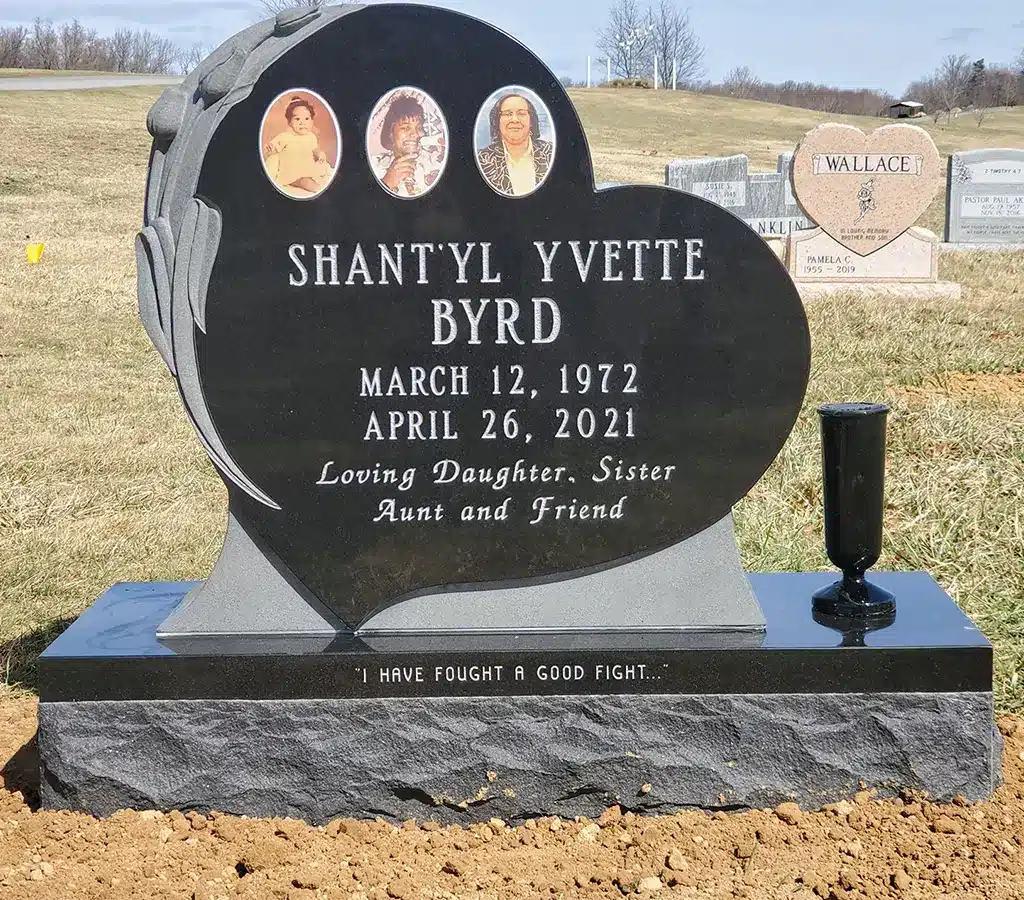
For generations, cemetery monuments were designed using paper sketches, pattern books, hand-cut stencils, and traditional carving methods. Families typically selected from a limited number of monument shapes, lettering styles, religious symbols, and decorative borders.
Those methods created many beautiful memorials, and traditional stoneworking skills remain essential today. However, modern technology has significantly expanded what families can see, customize, and approve before a monument is produced.
Digital design software, high-resolution photography, laser etching, computer-guided fabrication, and improved stoneworking equipment now allow monument designers to create highly personalized memorials with greater precision. A family can incorporate a portrait, meaningful landscape, handwritten message, military emblem, hobby, occupation, or architectural detail like a vase and memorial lights into a cohesive design that reflects an individual life.
Technology has not replaced the care and craftsmanship involved in creating a memorial. Instead, it has given experienced monument designers and craftspeople more ways to transform a family’s ideas into a permanent tribute.
Memorial Design Has Become More Personal
Historically, monument companies relied heavily on standardized design books. Families could choose among established shapes, floral patterns, borders, crosses, and lettering arrangements. These options remain popular because many traditional designs are timeless. The difference is that families are no longer limited to selecting a complete design exactly as it appears in a catalog. Modern memorial-design technology makes it easier to combine elements from different sources and create something original. A family may begin with a traditional upright monument but personalize it with:
- A laser-etched portrait
- A favorite landscape
- A military or public-service emblem
- A meaningful building
- A signature or handwritten message
- Images related to a profession
- Flowers with personal significance
- A family crest or cultural symbol
- A photograph of a couple
- Artwork representing hobbies or interests
Custom monument design is now less about choosing a template and more about deciding which parts of a person’s story should become part of the memorial.
Digital Design Makes the Memorial Easier to Visualize
One of the most important changes has been the transition from hand sketches to digital monument layouts.
Memorial-specific design programs allow designers to arrange the monument’s shape, granite color, lettering, artwork, panels, borders, and other elements on a computer. Industry software can create monuments, markers, columbaria, and mausoleums while allowing designers to compare layouts and granite colors before fabrication begins.
This provides several advantages.
More Accurate Proportions
A digital layout can be created according to the actual dimensions of the monument. The designer can evaluate whether:
- The family name is large enough
- Dates are easy to read
- The portrait has sufficient space
- The epitaph is appropriately positioned
- Artwork feels balanced
- Borders are proportionate
- Future inscriptions have enough room
This is especially important for companion monuments and family memorials, where the design may need to accommodate information that will be added years later.
Easier Design Revisions
Families often need to see a design before they know what they want to change. A portrait may feel too small. An epitaph may look better beneath the names. A floral design may need to be simplified to give the lettering more space.
Digital files make it easier to revise individual elements without recreating the entire drawing. Text can be resized, artwork repositioned, and different design options compared before the family makes a final decision.
Clearer Family Approval
Tegeler Monument Company provides a two-dimensional rendering for review before production begins. Families may request revisions before approving the final design. This helps confirm the monument’s wording, spacing, portrait placement, decorative elements, and overall appearance before permanent work is performed on the granite. A rendering cannot reproduce every natural variation in a piece of granite, but it gives the family a much clearer understanding of the intended memorial than a verbal description alone.
Laser Etching Has Expanded Memorial Artwork
Traditional sandblasting remains one of the most important methods used to create monument lettering and decorative designs. It produces recessed names, dates, borders, symbols, and artwork by directing abrasive material against areas exposed through a stencil.
Laser etching provides another option, particularly when a design requires photographic detail. A laser system follows digital instructions and makes thousands of small marks on a polished stone surface. On dark granite, the altered areas appear lighter, allowing the marks to collectively create highlights, shadows, texture, and depth.
Modern laser systems can reproduce:
- Individual portraits
- Couple and family photographs
- Pets
- Landscapes
- Religious imagery
- Military scenes
- Vehicles
- Buildings
- Nature scenes
- Detailed occupational symbols
- Custom illustrations
Black granite is especially effective because the lighter etched areas create strong contrast against the polished dark surface. Tegeler identifies solid black granite as the best choice for highly detailed laser-etched photographs and faces.
Laser technology gives families the ability to place recognizable imagery directly into the granite rather than relying only on traditional line drawings.
Photographs Can Be Prepared Specifically for Granite
Modern memorial design has also benefited from improvements in digital photography and image-editing software.
A photograph generally cannot be transferred to granite without preparation. A color image contains continuous variations of light, shadow, texture, and tone. A laser system must translate those variations into patterns that will remain visible against the polished stone.
Digital preparation may involve:
- Cropping the photograph
- Converting it to grayscale
- Removing a distracting background
- Increasing contrast
- Correcting uneven lighting
- Defining the eyes and facial features
- Repairing minor scratches
- Removing dust or discoloration
- Separating dark clothing from a dark background
- Resizing the image for the available memorial space
This process makes it possible to evaluate not only whether a photograph is meaningful, but whether it will reproduce effectively on the selected granite.
Older Photographs May Still Be Usable
The photograph a family values most may be decades old. It may have faded colors, small scratches, a busy background, or other people in the original composition.
Digital restoration can sometimes improve these photographs before they are converted into etching artwork. It may be possible to remove minor damage, isolate one person, adjust contrast, or simplify the surrounding scene.
Lettering Can Be Planned With Greater Precision
Names and dates are the foundation of most cemetery memorials. Modern design tools help monument professionals evaluate lettering before it is carved or sandblasted.
Designers can compare:
- Lettering styles
- Letter height
- Line spacing
- Character spacing
- Curved and straight arrangements
- Raised versus recessed lettering
- Family-name placement
- Epitaph length
- Inscription alignment
Memorial design systems allow lettering size, spacing, rotation, and other layout characteristics to be adjusted digitally.
Technology Has Expanded Custom Monument Shapes
Modern equipment has also increased the range of shapes and structural details that can be created consistently in granite.
Traditional monument forms remain widely used, including:
- Upright headstones
- Flat markers
- Bevel markers
- Slant monuments
- Companion monuments
- Benches
- Mausoleums
- Columbariums
Computer-guided design and fabrication tools can also support more complex shapes, curved panels, dimensional features, custom edges, and coordinated multi-piece memorials. CAD and CAM systems are used within the industry to connect digital monument designs with fabrication processes.
This can help families create memorial shapes related to:
- Religious architecture
- Hearts
- Open books
- Natural boulders
- Musical instruments
- Occupational symbols
- Family heritage
- Civic or military service
- A specific architectural style
Not every shape is permitted in every cemetery. The monument still must comply with the cemetery’s rules for dimensions, foundations, materials, and approved memorial types.
Families Can Compare Granite and Design Choices More Easily
Granite is available in many natural colors and patterns. The selected color affects not only the memorial’s appearance, but also which lettering and artwork methods will show clearly. Digital design tools can help families visualize how the same layout may appear on different granite colors. Some memorial-design systems include extensive granite-color libraries that allow designers to compare options within the same layout.
This can help demonstrate why traditional sandblasted lettering may show clearly on gray granite or deep lettering may need contrasting paint or lithochrome. Laser portraits generally appear most clearly on dark polished stone, and natural grain may affect the appearance of detailed artwork. The final decision should still be based on an actual granite sample whenever possible. Granite is a natural material, and no digital screen can perfectly reproduce its color, mineral pattern, or reflectivity.
Existing Memorials Can Be Documented and Matched
Technology can also help when a new monument must coordinate with an existing family memorial. A monument professional may use photographs, measurements, digital files, and detailed records to evaluate:
- Monument shape
- Granite color
- Lettering style
- Base dimensions
- Decorative borders
- Religious artwork
- Family-name placement
- Carving methods
Tegeler Monument Company can match new monuments and markers to existing memorials or recreate a style a family has seen and admired. An exact match may depend on the availability of the original granite and the condition of the existing stone. Nevertheless, detailed documentation and digital design tools can make it easier to create a visually coordinated memorial.
Design Technology Can Help Catch Errors Earlier
Names, dates, spelling, and cemetery dimensions must be checked carefully before production. Modern technology cannot eliminate the need for human review, but it can make the approval process more organized. A complete digital proof allows the family and monument company to review the same layout.
Families should verify:
- Correct spelling of every name
- Birth and death dates
- Middle names and initials
- Military rank or branch
- Punctuation
- Religious text
- Epitaph wording
- Portrait selection
- Symbol placement
- Monument dimensions
- Future inscription areas
Once lettering or artwork has been permanently placed into the granite, corrections may require significant repair or replacement. Digital approval creates an important opportunity to catch an issue while it can still be changed easily.
Cemetery Compliance Remains Essential
Technology may expand what is technically possible, but the cemetery determines what is permitted on a particular lot. Cemetery requirements may regulate:
- Monument height and width
- Base dimensions
- Granite color
- Marker style
- Number of memorials
- Portraits and photographs
- Benches
- Vases
- Foundations
- Installation procedures
- Religious or decorative elements
A highly detailed digital design cannot move into production until the proposed memorial is compatible with the cemetery’s regulations. Working with an experienced local monument company can make this process easier. Tegeler coordinates with cemeteries and helps families understand the requirements that affect monument selection, design, and installation.
Technology Has Improved the Design Process, Not Removed the Human Element
A monument is not an ordinary manufactured product. It represents a person, a family, and a place of permanent remembrance. Software can position a portrait accurately. A laser can reproduce fine detail. Computer-guided equipment can assist with precise fabrication. None of those tools can decide which expression best reflects a loved one, which verse brings comfort, or which details should define the memorial. Those decisions still require conversation, judgment, and empathy.
Experienced monument professionals remain responsible for:
- Listening to the family
- Interpreting personal ideas
- Evaluating photographs
- Recommending appropriate granite
- Balancing the composition
- Checking cemetery requirements
- Selecting suitable fabrication methods
- Inspecting the finished memorial
- Coordinating careful installation
Modern equipment is most valuable when it is guided by people who understand both memorial design and traditional stone craftsmanship.
Modern Technology and Traditional Craftsmanship Work Together
Today’s cemetery monuments can contain extraordinarily detailed artwork, but they are still built from enduring natural materials using skills developed across generations.
A single memorial may combine:
- A computer-generated layout
- A digitally restored photograph
- Laser-etched artwork
- Sandblasted lettering
- Hand-finished details
- Custom-cut granite
- Bronze emblems or plaques
- Traditional foundation and installation methods
This combination allows families to benefit from modern precision without losing the character and permanence associated with a handcrafted granite monument.
Tegeler Monument Company has served families since 1897, long before digital renderings and laser etching became part of memorial design. Today, these technologies complement the company’s established craftsmanship and personal approach.
Frequently Asked Questions About Modern Memorial Design
Can I see my headstone design before it is made?
Yes. Tegeler Monument Company provides a two-dimensional rendering for review and approval before work begins. Families may request revisions to the proposed design.
Can a photograph be added to a granite headstone?
Yes. A photograph may be reproduced as a laser-etched portrait on suitable dark polished granite. Cameo photographs may provide another option, particularly when a family wants a color image or has selected lighter granite.
Can handwriting be reproduced on a monument?
In many cases, a clear sample of handwriting or a signature can be digitally prepared and converted into memorial artwork. The original sample must be evaluated for clarity and suitability.
Can several photographs be combined?
Separate photographs may sometimes be prepared and combined into a unified design. The result depends on image quality, lighting, perspective, available space, and the intended monument layout.
Are laser etching and sandblasting the same?
No. Sandblasting is frequently used to create recessed lettering, dates, borders, and traditional designs. Laser etching is generally used for fine surface imagery, including portraits and detailed scenes. Both methods can appear on the same granite memorial.
Can technology guarantee an exact photographic copy?
No. A laser-etched portrait is an artistic interpretation rendered in the contrast between polished and etched granite. The original photograph, stone color, portrait size, digital preparation, and natural characteristics of the granite all influence the finished appearance.
Can any custom monument design be installed in a cemetery?
No. Every design must comply with the rules of the cemetery where it will be installed. Approval may depend on size, shape, material, foundation, artwork, and other requirements.
Does modern equipment make craftsmanship less important?
No. Technology can improve precision and expand design options, but successful memorial creation still requires experienced design, stone selection, production oversight, finishing, inspection, and installation.
Creating a Memorial for the Next Generation
Modern technology has changed how families participate in cemetery monument design. They can review a detailed layout, compare options, restore meaningful photographs, incorporate highly personal artwork, and understand how the finished memorial will be organized before production begins. The result is not simply a more modern headstone. It is a more collaborative and individualized design process.
Tegeler Monument Company combines modern memorial-design capabilities with more than a century of experience serving families. Our team can help you select granite, develop a custom layout, prepare portrait artwork, review cemetery requirements, and create a memorial that reflects the life and legacy of your loved one.
Contact Tegeler Monument Company to begin designing a custom headstone, laser-etched memorial, granite grave marker, companion monument, memorial bench, columbarium, or cemetery monument in Maryland, Washington, D.C., Virginia, Pennsylvania, West Virginia, or the surrounding region.
Comments are closed