
Choosing a headstone for a husband and wife can be especially difficult when one spouse has died and the other is still living. The surviving spouse may want to create a permanent memorial now while also making sure the monument can eventually represent both people.
Fortunately, double headstones, also called companion headstones, companion monuments, or husband-and-wife headstones, are specifically designed to accommodate this situation. A monument can be installed after the first spouse dies with space reserved for the surviving spouse’s future death date and, depending on the design, additional inscriptions, artwork, or epitaphs.
For families choosing double headstones in Maryland, planning the layout carefully now can make future inscription work easier while creating a monument that looks complete even before the second spouse’s information is added.
Can You Put a Living Spouse’s Name on a Headstone?
Yes. It is common for a companion headstone for a husband and wife to include both spouses’ names even though only one has died.
The monument might show:
Robert J. Smith
1945–2026
Mary A. Smith
1948–
The surviving spouse’s name and birth year are engraved when the monument is created, while the death date is left blank. After that person dies, the monument company can add the final date.
Another option is to leave the surviving spouse’s entire individual inscription area blank. Which approach makes the most sense depends on the family’s preferences, cemetery requirements, and overall monument design.
Importantly, a double headstone does not have to look unfinished simply because one spouse is still living. An experienced monument designer can intentionally balance the lettering, artwork, and blank space so the memorial looks appropriate both now and decades later.
1. Traditional Side-by-Side Double Headstone Layout
One of the most recognizable double headstone designs for married couples places each spouse’s information on a separate side of an upright granite monument.
Each side can include:
- Full name
- Birth date
- Death date
- Individual epitaph
- Religious symbol
- Military emblem
- Etched image or other personal artwork
A shared family name is often engraved prominently across the monument.
This layout works particularly well when one spouse is still living because the monument naturally creates two defined spaces. The deceased spouse’s inscription can be completed while the surviving spouse’s side contains a name and birth date with room for the future date.
2. Shared Surname With Individual Names Below
Couples who share a surname may choose to make the family name the visual centerpiece of the monument.
For example:
SMITH
Robert J.
1945–2026
Mary A.
1948–
This creates a unified husband-and-wife memorial while still giving each person a distinct place on the stone.
The layout can also leave room beneath the names for a shared sentiment such as a wedding date, brief epitaph, religious verse reference, or phrase meaningful to the couple.
This style can be particularly effective on upright companion monuments, where the larger surface provides more flexibility for lettering and artwork.
3. Double Heart Headstone Layout
A double heart headstone visually separates the memorial into two connected sections, making it a natural choice for married couples. One heart can contain the completed inscription for the spouse who has died while the other contains the living spouse’s name and birth date.
The center or surrounding portions of the monument can incorporate shared elements such as:
- Wedding rings
- A wedding date
- Roses or other flowers
- Crosses or religious imagery
- A family name
- A shared epitaph
- An etched wedding or family portrait
For couples who want a monument to emphasize their marriage rather than simply place two individual inscriptions beside one another, a double heart monument can make that relationship part of the physical design.
4. Shared Center Design With Names on Either Side
Not every companion headstone needs to divide the stone directly down the middle. Another option is to place a meaningful design in the center with each spouse’s information positioned on opposite sides. The central artwork could include a cross, tree, landscape, church, wedding rings, flowers, family imagery, or another symbol representing something the couple shared. This can be especially useful when the surviving spouse wants the monument to commemorate the relationship while still allowing room for each person’s individual information.
5. Shared Portrait With Individual Inscriptions
Modern monument design makes it possible to incorporate highly detailed etched portraits into granite. A couple may choose a wedding photograph, anniversary portrait, or another favorite image of themselves together. Their individual names and dates can then be arranged beneath or beside the portrait. When one spouse is still living, the design can be completed except for that person’s death date.
Before choosing a large portrait, however, families should think carefully about how much room remains for future lettering. The monument needs enough open space for the final inscription to be added cleanly later.
6. A Shared Epitaph With Separate Names and Dates
Not every couple wants separate epitaphs. A husband-and-wife headstone can instead contain one phrase representing the couple together, with their names and dates appearing elsewhere on the monument. A shared inscription might refer to their marriage, family, faith, or life together. This approach can free up considerable design space and often creates a cleaner appearance than trying to fit two separate epitaphs onto the stone.
7. Include the Wedding Date
For some couples, the date they married is nearly as important to the memorial as their birth and death dates. A wedding date can be incorporated between the spouses’ inscriptions, beneath their names, alongside wedding rings, or as part of a shared epitaph.
It can be particularly meaningful when the surviving spouse is involved in designing the monument because the stone becomes not only a marker of death but also a record of the life the couple created together.
8. Design the Monument Around Two Individual Lives
Marriage is an important part of someone’s life, but it does not necessarily need to erase each spouse’s individuality. A double headstone for husband and wife can incorporate different imagery for each person.
One side might include a military emblem while the other includes flowers. One spouse might have a cross while the other has another meaningful symbol. Hobbies, occupations, landscapes, organizations, and personal interests can also inspire the artwork.
The key is creating enough visual consistency that the monument still looks like one cohesive memorial.
9. Leave the Living Spouse’s Side Mostly Blank
Some surviving spouses are uncomfortable seeing their own future memorial inscription completed during their lifetime. That is understandable, and engraving the living person’s name in advance is not the only option. Instead, the monument can be designed with an intentionally reserved area. This requires more planning than simply leaving an arbitrary empty section. The monument designer needs to determine where the eventual name and dates will go and reserve enough room for the anticipated lettering. Families should also retain the monument’s design information when possible so future lettering can closely match the original inscription.
10. Consider a Companion Crypt or Mausoleum Memorial
A shared memorial does not necessarily have to be a traditional double headstone. Couples may instead choose a companion crypt, private family mausoleum, or mausoleum inscription designed for two people. The same basic planning principle applies: the memorial can recognize the spouse who has died while reserving space for the surviving spouse. Families do not need a private mausoleum to apply the same idea. A companion headstone can similarly be designed as a shared memorial from the beginning even though only one spouse has died.
Famous Couples and Shared Memorials
Companion memorials have a long history, and looking at well-known couples can sometimes help families think beyond the standard “two names and two dates” format.
Johnny Cash and June Carter Cash
Johnny Cash and June Carter Cash demonstrate a very different approach. They have separate but neighboring memorials at Hendersonville Memory Gardens rather than one conventional double headstone. Their large recessed markers visually coordinate with one another and include bronze reproductions of their signatures, giving the stones an unusually personal element. Visitors also frequently leave flowers, coins, guitar picks, candles, and other mementos around the graves.
This approach can provide inspiration for couples who want their monuments to clearly belong together without making them identical. Coordinating granite, proportions, lettering, borders, or placement can visually connect two markers, while individual signatures, epitaphs, artwork, or symbols preserve each spouse’s personality. It is a useful alternative when a couple wants the cemetery space to read as a shared memorial while still having two distinct stones.
The Bush Family
The graves of George H.W. Bush and Barbara Bushv offer another example of a restrained, traditional approach to a couple’s memorial. They are buried beside their daughter Robin on the grounds of the George H.W. Bush Presidential Library and Museum in College Station, Texas. Rather than relying on elaborate portraits or highly decorative imagery, the burial site uses simple, substantial stone markers surrounded by carefully maintained landscaping, creating a quiet family memorial within the larger presidential library grounds.
Aesthetically, the site is defined by its symmetry, natural surroundings, and understated stonework. The markers feel permanent and dignified without competing with the landscape around them. For families considering a husband-and-wife monument or companion headstone, the Bush memorial demonstrates how effective a relatively simple design can be. Matching granite, consistent lettering, balanced placement, and restrained ornamentation can visually connect two spouses without requiring a highly elaborate double monument.
Dolly Parton and Carl Dean
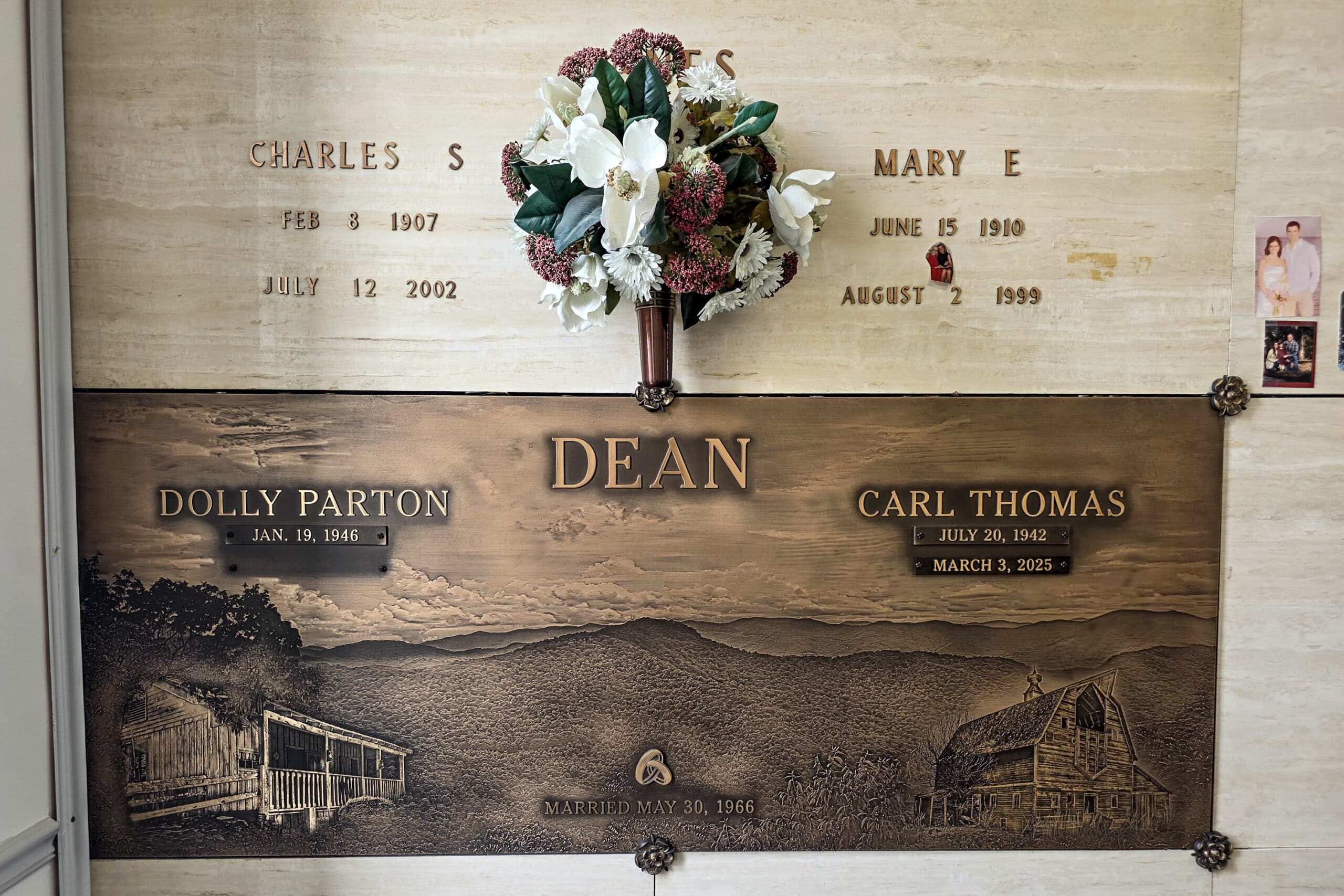
Dolly Parton and Carl Dean’s shared mausoleum memorial offers a much more personalized approach. After Dean’s death in 2025, he was placed in a private mausoleum at Woodlawn Memorial Park in Nashville that Parton had planned as the couple’s eventual shared resting place. The bronze crypt front incorporates both Dolly and Carl’s names, their wedding date, intertwined wedding rings, and a mountain landscape, creating a design centered on their marriage and their Tennessee roots.
The aesthetics are especially relevant for families designing a companion monument while one spouse is still living. Instead of leaving an obviously empty second half, the memorial was conceived as a complete composition from the beginning. The wedding rings visually connect the two names, the wedding date records the beginning of their life together, and the mountain imagery provides a sense of place and shared identity. The result demonstrates how a monument can acknowledge the surviving spouse without making the memorial feel unfinished.
Although the Parton-Dean memorial is a mausoleum rather than a traditional double headstone, many of the same ideas translate beautifully to granite. Interlocking rings, a wedding date, mountain or landscape etchings, a shared surname, flowers, religious imagery, or another symbol meaningful to both spouses can occupy the center of a double headstone, with each person’s name and dates arranged around it. This type of layout makes the monument feel like a memorial to a shared life rather than simply two individual inscriptions placed on the same stone.
The Reagans
Ronald and Nancy Reagan provide an example of a couple memorialized together within a larger memorial setting. Ronald Reagan was buried at the Ronald Reagan Presidential Library in California after his death in 2004, and Nancy Reagan was buried beside him following her death in 2016. Their final resting place emphasizes their relationship while remaining part of a memorial devoted to Reagan’s public life.
Should the Living Spouse’s Death Date Space Be Left Blank?
Yes. If the living spouse’s name and birth date are engraved, the death date area is simply left open. But the amount of blank space matters.
The monument designer should account for the eventual date before determining the placement of surrounding artwork, epitaphs, borders, and other lettering. A design that looks attractive today should still look balanced when that final information is added.
This is one reason it can be helpful to work with a monument company when planning a pre-need companion headstone rather than simply adding a second name to a design created only for the deceased spouse.
What Happens When the Second Spouse Dies?
When the surviving spouse eventually passes away, the missing information can generally be added to the existing monument. Depending on the monument and cemetery, the final inscription may be completed at the cemetery or the stone may require other arrangements for the work. Planning ahead helps ensure that the future lettering can match the existing:
- Font
- Letter size
- Spacing
- Carving style
- Finish
- Overall layout
Granite can last for generations, which means the second inscription may be added many years after the first. Keeping records of the original monument design can therefore be valuable.
Which Person Goes on Which Side of a Double Headstone?
There is no universal rule requiring the husband to appear on one particular side and the wife on the other. Placement can depend on burial positions, cemetery requirements, family preference, monument design, and tradition. Before finalizing the engraving, the monument company should confirm the grave locations and cemetery requirements. This is particularly important when a double monument spans two burial plots.
Should You Buy the Double Headstone Now or Wait Until Both Spouses Have Died?
For many families, there are practical advantages to choosing the companion monument after the first spouse dies. The surviving spouse can participate directly in decisions about the granite, shape, wording, artwork, and overall appearance. It also avoids leaving the first grave without its intended permanent memorial for potentially many years.
Planning now can also help ensure that sufficient space is reserved for both spouses from the beginning.
Waiting may make sense in some circumstances, particularly when future burial plans remain uncertain. A surviving spouse who may eventually choose cremation, burial elsewhere, or a different cemetery should consider those possibilities before committing to a shared monument.
Check the Cemetery’s Rules Before Finalizing a Double Headstone
One of the most important steps happens before the monument is ordered. Cemeteries can establish requirements regarding monument dimensions, materials, foundations, placement, vases, and whether upright monuments are permitted in a particular section. Two adjacent burial spaces do not automatically mean that any double headstone will be permitted. Families considering a double headstone in Maryland should verify the cemetery’s requirements before settling on a specific size or design. An experienced Maryland monument company can help families navigate these requirements and determine which companion monument options are appropriate for the cemetery.
Double Headstone Options for Maryland Families
A shared monument can take many forms, including:
- Upright double headstones
- Double heart monuments
- Double slant monuments
- Double flat grave markers
- Companion monuments with vases
- Custom granite monuments
- Coordinating individual markers
- Family monuments
- Mausoleum and crypt memorialization
The best choice depends on the cemetery, burial arrangement, available space, budget, desired amount of personalization, and how much future information needs to be accommodated.
Questions to Ask When Designing a Companion Headstone
Before approving the design, ask:
- Does this cemetery permit a companion monument across these two spaces?
- What maximum dimensions are allowed?
- Will both names be engraved now?
- How will the living spouse’s future death date be added?
- Is enough space reserved for the future inscription?
- Can the original lettering style be reproduced later?
- Does the design still look complete while one date remains blank?
- Are vases permitted?
- Can additional artwork or inscriptions be added later?
- Who keeps the monument design and inscription records?
- What happens if the surviving spouse ultimately chooses cremation?
- Does the cemetery require a particular foundation or installation method?
These details are much easier to address while the monument is being designed than years after it has been installed.
Designing a Double Headstone in Maryland
When one spouse dies first, a companion monument has an unusual job: it must memorialize one life now while anticipating another inscription that may not be completed for many years. That does not mean the headstone has to look unfinished.
With thoughtful planning, double headstones for married couples can incorporate both spouses’ names, shared artwork, wedding dates, portraits, epitaphs, religious imagery, vases, and individual details while reserving exactly the right amount of space for the future.
Tegeler Monument Company works with families throughout Maryland and the surrounding region to design custom headstones, double headstones, companion monuments, grave markers, and cemetery monuments that comply with cemetery requirements while reflecting the people they commemorate.
If you are choosing a monument after the death of a spouse, Tegeler can help you determine what should be engraved now, what should be reserved for later, and how to create a memorial that feels complete at every stage.
Frequently Asked Questions
What is a headstone for two people called?
A headstone designed to memorialize two people is commonly called a double headstone, companion headstone, companion monument, or double monument. These are frequently used for married couples but can also memorialize siblings, parents, or other family members.
Can you put two names on a headstone before both people die?
Yes. A living person’s name and birth date can be engraved on a companion monument, with space left for the death date to be added later. Cemetery policies should always be confirmed before the monument is finalized.
Can a husband and wife have one headstone?
Yes. One monument can memorialize both spouses when the cemetery and burial arrangement permit it. Upright companion headstones, double heart monuments, slant monuments, and flat companion markers are among the available options.
Does the husband or wife go on the left side of a double headstone?
There is no universal rule. The layout should take into account the actual burial locations, cemetery requirements, family preferences, and the overall monument design.
Can you add a death date to a headstone later?
Yes. Adding a final date after the second spouse dies is a common part of companion monument planning. The original design should leave adequate room so the future inscription fits naturally.
Can a double headstone have two different epitaphs?
Yes. Each spouse can have an individual epitaph, or the couple can have one shared inscription. The best option often depends on the amount of available engraving space.
Can a double headstone include two pictures?
Depending on the monument material, size, design, and cemetery rules, a companion monument may incorporate individual portraits or a shared image of the couple. Granite etching and ceramic memorial portraits are among the possibilities.
Can one spouse be buried and the other cremated with a shared monument?
Potentially. Cemetery policies determine whether cremated remains can later be placed in the same grave, an adjacent space, or another permitted location. Families anticipating different burial choices should discuss this before designing the monument.
Can you add a vase to a double headstone?
Many companion monuments can incorporate one or two vases, but cemetery regulations may limit the number, material, size, or placement of vases.
How do I choose a double headstone in Maryland?
Start by confirming the cemetery, grave locations, monument-size restrictions, and permitted monument styles. From there, a Maryland monument company can help determine the appropriate granite, dimensions, layout, inscriptions, artwork, and space needed for future lettering.
Comments are closed